


Despite the state’s declared commitment to strengthening tobacco and nicotine control measures and fulfilling its international obligations under the WHO Framework Convention on Tobacco Control (WHO FCTC), in 2024 the Verkhovna Rada of Ukraine adopted a law that legalized remote sales of tobacco and nicotine products in Ukraine, creating conditions for wider access to these products, including among children and adolescents.
The purpose of this publication is to examine the tobacco industry’s interference on the legalization of remote tobacco sales in Ukraine and to assess how this affects public health policy.
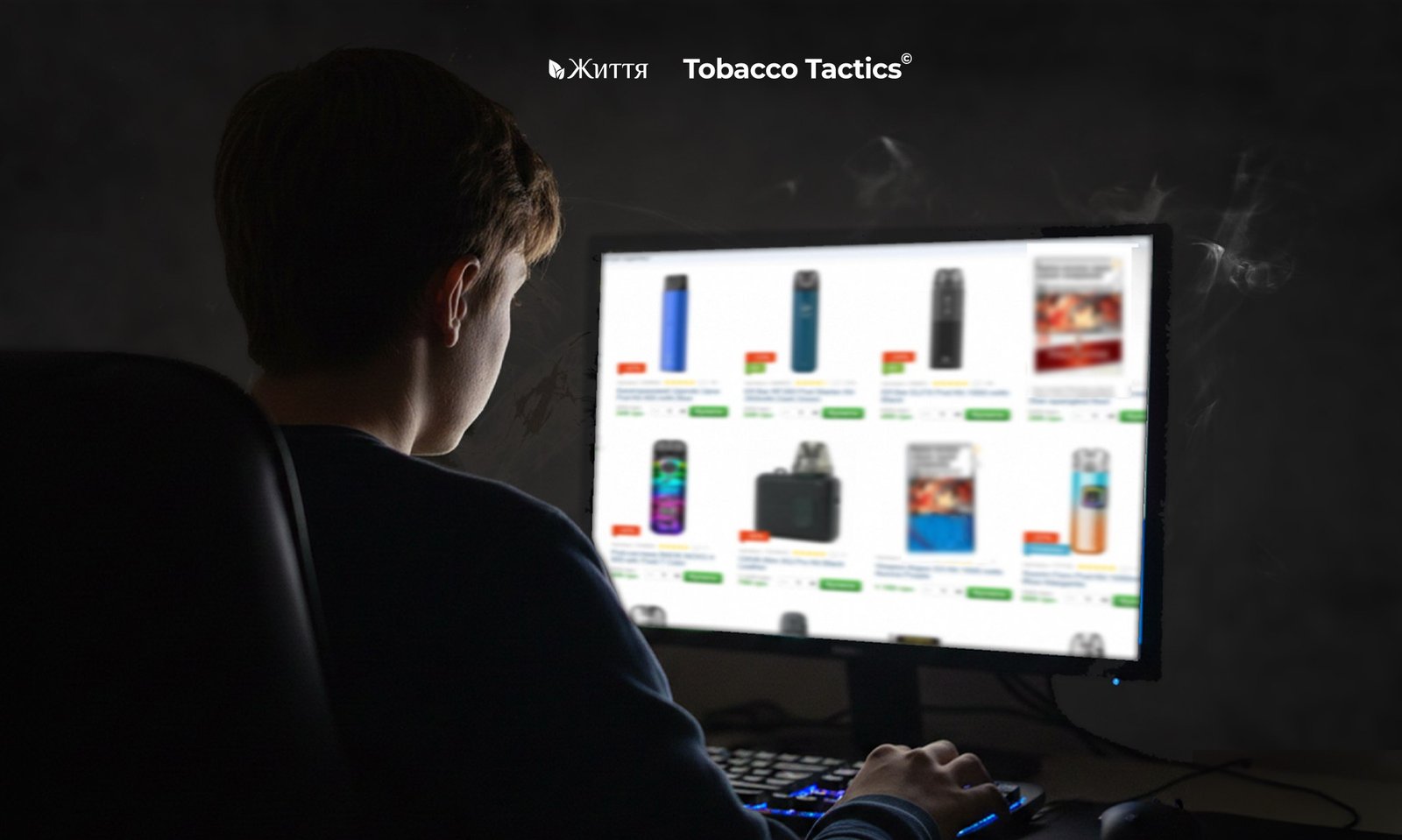
The Guidelines for implementation of Article 13 of the WHO FCTC state that online sales of tobacco products inherently involve advertising and promotion. According to the decision at the Conference of the Parties FCTC/COP/3/9 of 2 September 2008, the most effective way to avoid online promotion of tobacco products is to ban remote tobacco sales. Where bans are not yet implemented, it is recommended to limit online sales to text‑only product lists with prices, without images or any promotional elements.
A prohibition on remote sales helps reduce the level of illicit trade in tobacco products and aligns with Article 11 of the Protocol to Eliminate Illicit Trade in Tobacco Products, which stipulates that each Party should consider banning retail sales of tobacco products via the Internet, telecommunications, or any other modern technological means of sale.
Until 2024, Law of Ukraine No. 481/95‑VR prohibited sales of tobacco products in unspecified locations, which effectively excluded their distribution via online stores. The law required that tobacco sales take place only:
1) in designated retail locations that are physical premises,
2) subject to license,
3) and with age verification upon request by the seller.
These requirements ensured control over the placement of tobacco products and the responsibility of the seller and business entity for proper age verification. According to data from the State Tax Service of Ukraine, online sales of tobacco products directly contradicted the legislation in force at that time.
Despite the position of the Ministry of Health of Ukraine and numerous comments from public health experts, on 18 June 2024 the Verkhovna Rada adopted, in the second reading, Draft Law No. 10346 “On State Regulation of the Production and Circulation of Ethyl Alcohol, Distilled Spirits, Bioethanol, Alcoholic Beverages, Tobacco Products, Tobacco Raw Materials, Liquids Used in Electronic Cigarettes, and Fuel”. The law entered into force on 27 July 2024 after being signed by the President.
One of its innovations introduced the possibility of conducting remote sales of tobacco and nicotine products using electronic communication tools. This step contradicts MPOWER policies and the provisions of the WHO FCTC, as it significantly expands access to these products, particularly for children and adolescents, undermining state efforts to reduce levels of tobacco (nicotine) addiction.
According to the updated version of the Law, the provisions on the online sale of tobacco and nicotine products will enter into force on 1 November 2026.
The initiator of the draft law was the Chair of the Committee on Finance, Tax, and Customs Policy, Danylo Hetmantsev. Co‑authors included Members of Parliament Ihor Marchuk, Yaroslav Zhelezniak, Maryana Bezuhla, Ihor Vasyliev, Oleksandr Sova, Vasyl Virastiuk, Viktoriia Kinzburska, and Serhii Shvets.
In its conclusion on Draft Law No. 10346, the Verkhovna Rada Committee on National Health, Medical Care and Health Insurance recommended removing provisions introducing remote sales of tobacco products, electronic cigarettes, and alcoholic beverages, leaving sales of such products permissible only in designated retail locations, as required by existing legislation.
According to research by the Kyiv International Institute of Sociology (KIIS), only 2.8% of tobacco consumers in Ukraine purchase such products remotely. This indicates that banning online sales would have minimal economic impact on the market while significantly reducing risks of youth access to tobacco products.
During the meeting of the Committee on Finance, Tax, and Customs Policy on Draft Law No. 10346 members of Parliament Danylo Hetmantsev and Yaroslav Zhelezniak argued that banning remote sales would harm legitimate businesses and strengthen illicit producers and distributors. This position reflects the commercial interests of the tobacco industry, as it expands distribution channels and increases sales potential among younger generations, who more actively use online services.
However, this argument fails to consider the key risk — the lack of effective age‑verification mechanisms during online orders and the inability to ensure that tobacco and nicotine products are received by adults. Under such conditions, remote sales significantly increase the likelihood of children and adolescents purchasing tobacco products, further exacerbating the issue of accessibility and contradicting public health goals.
During public monitoring conducted while Draft Law No. 10346 was under review, it was found that 10 out of 10 major supermarket chains offering online delivery sold tobacco and alcohol products to a 14‑year‑old volunteer without any age or ID verification. These findings demonstrate systematic violations of the law and show how the industry leverages online sales to increase profits at the expense of children’s and youth health.
Additionally, in April 2024, during discussions on Draft Law No. 10346, the Chair of the Verkhovna Rada Committee on Finance, Tax, and Customs Policy, Danylo Hetmantsev, attended events organized by Healthy Initiatives — an organization funded by Philip Morris — with participation of “Ukrtyutiun,” an association founded by four transnational tobacco companies (Imperial Tobacco, British American Tobacco, Japan Tobacco International, and Philip Morris).
According to the World Health Organization, tobacco kills more than 8 million people annually, including 1.3 million non‑smokers exposed to second‑hand smoke. The Ukrainian economy loses approximately 3.2% of its GDP annually due to healthcare costs associated with diseases caused by active and passive smoking, reduced work capacity, and premature mortality. The Public Health Center of the Ministry of Health of Ukraine reports that more than 100 000 people die prematurely each year from diseases caused by tobacco use.
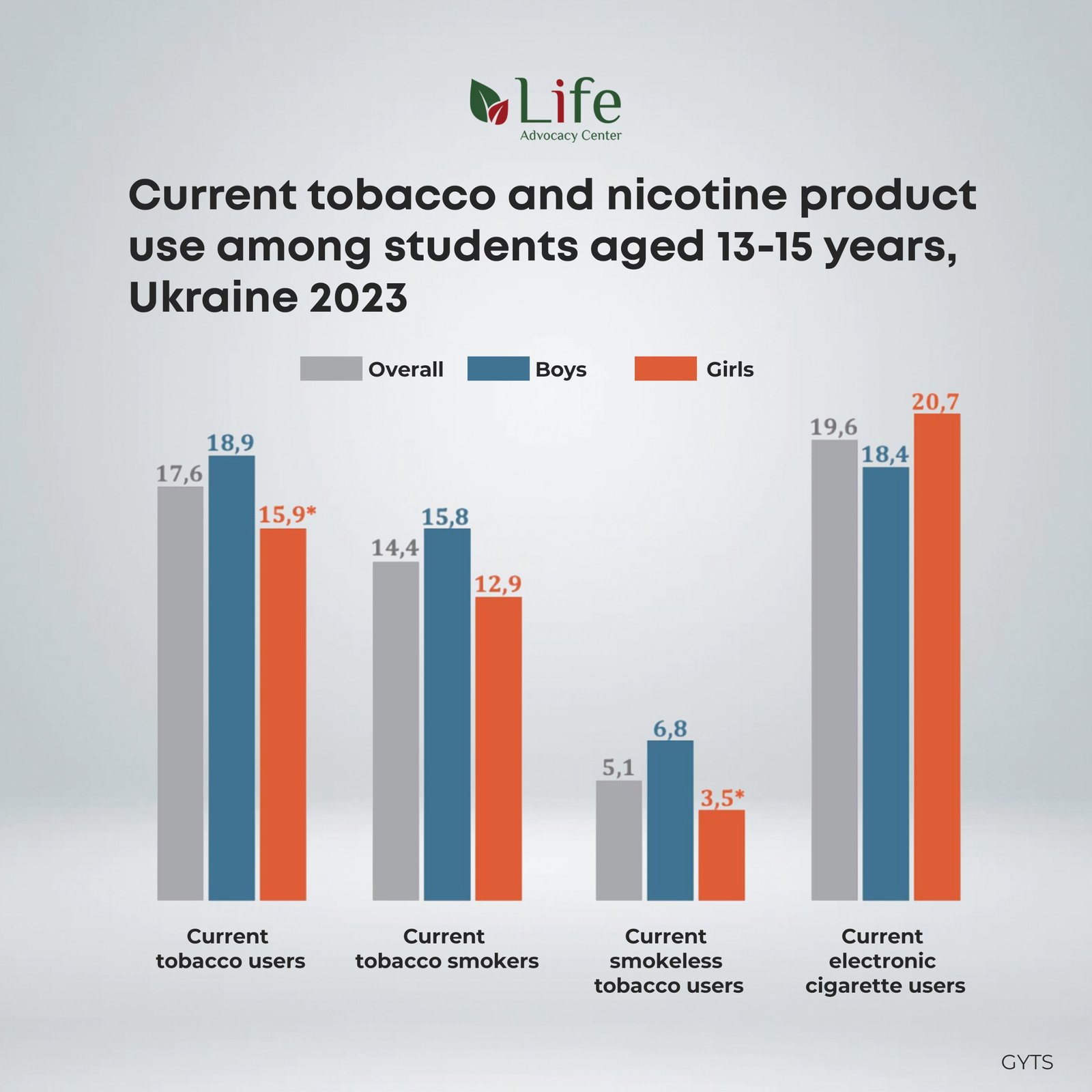
According to the Global Youth Tobacco Survey (GYTS) presented by WHO in June 2025, 18% of students aged 13–15 use tobacco products, and 20% use electronic cigarettes. Legalizing remote sales will further increase youth access to tobacco and nicotine products, contributing to higher consumption and complicating efforts to prevent addiction and protect the health of younger generations.
A ban on online sales of tobacco products exists in more than 50 countries worldwide, with many European states among them: Estonia, Finland, France, Latvia, the Netherlands, Poland, Slovenia, Spain, and others.
Thus, the introduction of remote sales of tobacco and nicotine products in Ukraine in 2024 demonstrated how vulnerable public health policy remains to the commercial influence of the tobacco industry. Article 5.3 of the WHO FCTC and Article 4 of Law No. 2899‑IV of Ukraine require prioritizing public health over financial, tax, and corporate interests of businesses linked to the tobacco industry.
International experience and WHO FCTC provisions clearly show that online tobacco sales inherently promote advertising and accessibility, while prohibiting such sales is the most effective mechanism for protecting children and adolescents.
[1] https://zakon.rada.gov.ua/laws/show/897_001#Text
[3] https://apps.who.int/gb/fctc/pdf/cop3/fctc_cop3_9-en.pdf
[4] https://fctc.who.int/protocol
[5] https://zakon.rada.gov.ua/laws/show/481/95-%D0%B2%D1%80#Text
[6] https://tax.gov.ua/nove-pro-podatki–novini-/471415.html
[7] https://itd.rada.gov.ua/billinfo/Bills/Card/43387
[8] https://itd.rada.gov.ua/billInfo/Bills/Card/43387
[9] https://www.kiis.com.ua/?lang=ukr&cat=reports&id=1240&page=1
[13] https://www.tobaccotactics.org/article/healthy-initiatives/
[14] https://www.who.int/news-room/fact-sheets/detail/tobacco
[15] https://www.ncbi.nlm.nih.gov/pmc/articles/PMC5801657/