


For years, the tobacco industry has used the argument of illicit trade as a universal tool to pressure governments. Whenever discussions arise about increasing excise taxes, introducing new restrictions, or strengthening control over tobacco and nicotine products, the industry warns that stricter rules will allegedly lead to a surge in contraband. To support this narrative, tobacco companies commission research from private consulting firms.

At the same time, international data show that studies funded by the tobacco industry, including those on the illicit trade of tobacco products, are unreliable, serve exclusively the commercial interests of the tobacco industry, and cannot be used as a basis for public policy-making.
In Ukraine, a key source of such data is the Kantar Ukraine reports on monitoring the illicit trade of tobacco products, prepared on commission from the tobacco manufacturers themselves. This fact alone creates an obvious conflict of interest: the research methodology is not fully transparent to the public, and the results are systematically used in public debates to justify the need to relax government regulation. However, a detailed analysis of these reports shows that the problem lies not only in the lack of transparency but also in manipulation of how the results are presented, which can mislead government officials, parliamentarians, and the expert community.
A striking example of possible data manipulation is the change in Kantar Ukraine’s methodological approach at the turn of 2020–2021. In the Kantar Ukraine report “Illicit Tobacco Market Research: 2020 Results” (24 December 2020), only two main categories of illicit products were highlighted:
The products of certain manufacturers, in particular the Vynnyky Tobacco Factory, as stated in the Kantar Ukraine report, were produced without paying taxes and labeled Duty Free/Export, which are likely illegal tobacco products, and were grouped into one category with smuggled goods.
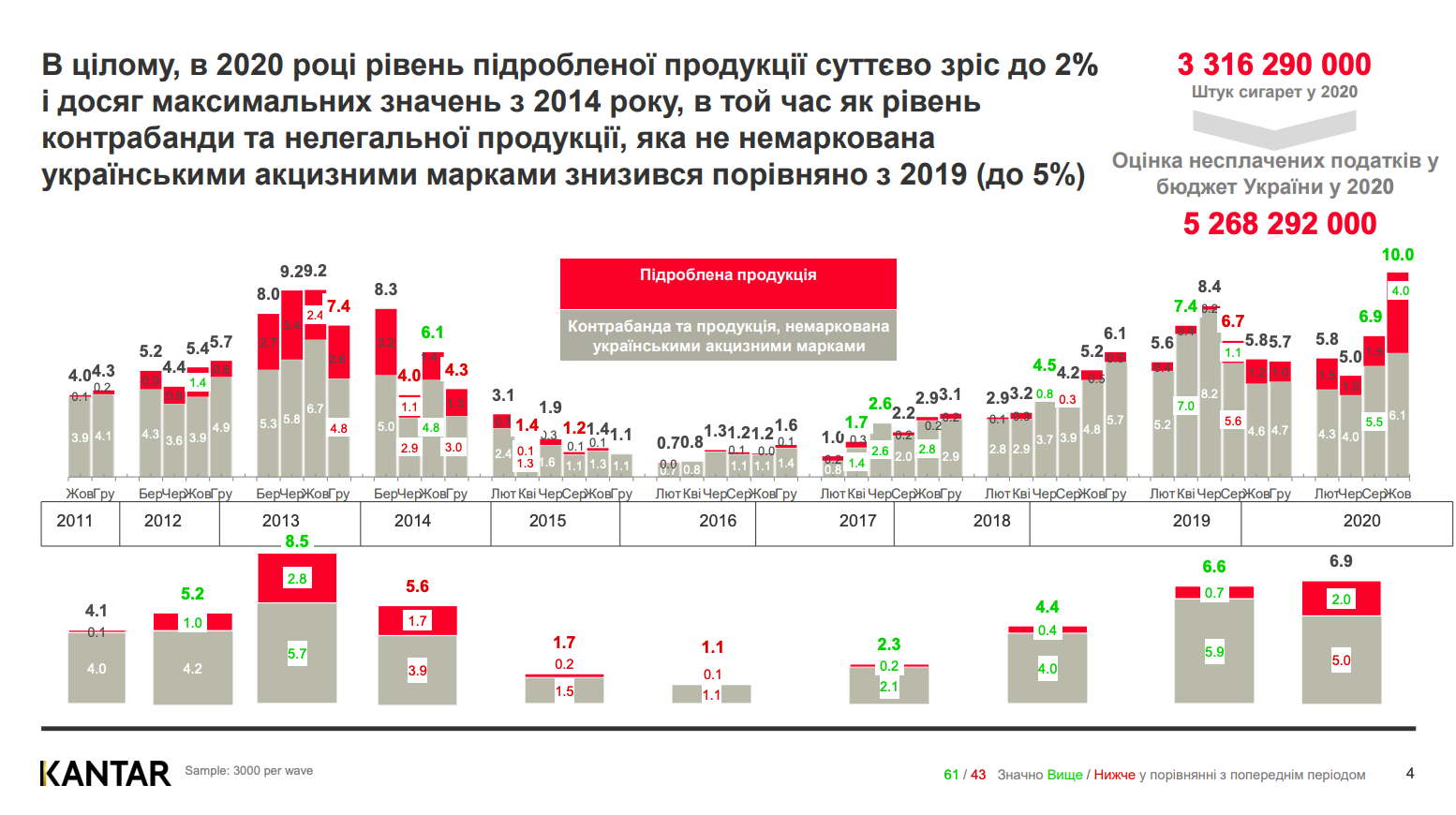
It is important to note that smuggling is defined in the Criminal Code of Ukraine as the movement of excise goods across the country’s customs border either without customs control or by concealing them from customs control. It is obvious that tobacco products manufactured in Ukraine cannot be considered smuggled, as indicated in Kantar Ukraine reports up to October 2020.
The likely aim of this approach was to mislead government officials, parliamentarians, the public, and the expert community about the sources of illicit tobacco products, thereby hindering effective measures to reduce tobacco and nicotine consumption. Data from the report indicate that the main source of illicit tobacco products in Ukraine was a legal tobacco factory. However, the research company classified this category as “contraband,” i.e., illegally imported into the country. Instead, it would be appropriate to classify such products as illegal tobacco products, likely manufactured within the territory of Ukraine.
Starting in February 2021, the research methodology was revised: a third category was introduced—“Duty Free or Export-Labeled Products Illegally Sold in Ukraine” (Illicit Tobacco Market Research: February 2021 Results, May 2021).
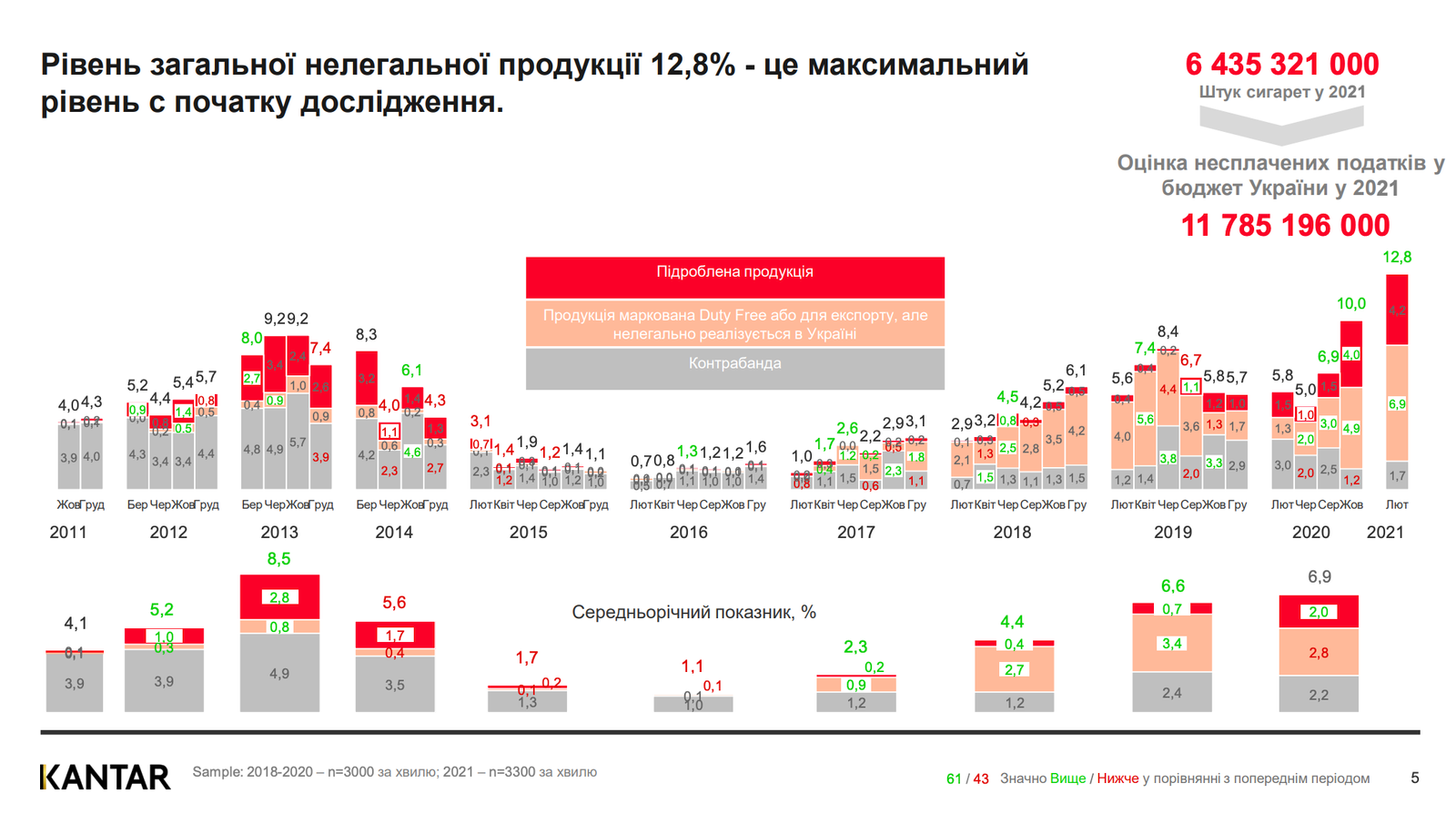
Crucially, this category was not only applied to current data but was also reflected in charts and comparative materials for previous years. In effect, this represents a retrospective revision of the illicit market structure. This suggests that researchers had both the technical and analytical capacity to correctly identify the source of illicit products earlier but, for certain reasons, did not do so.
Such a shift in approach indicates that continuing to misrepresent the scale of illicit production by legal Ukrainian factories under the guise of “foreign contraband” had become unnecessary for the tobacco industry’s commercial interests.
For years, the research company misleadingly focused primarily on the issue of cigarette smuggling (illegal importation), while, according to its own data, the main source of illicit products was illegal tobacco manufactured domestically. This approach clearly did not reflect the actual structure of the illicit market and could lead to ineffective regulatory decisions. The tobacco industry used[][][] this in its commercial interests to oppose tobacco excise tax increases and to slow down or delay excise policy implementation without proper analysis of the actual scale and sources of illicit tobacco products. Systematic research confirms that such industry practices are aimed at discrediting and undermining effective measures to reduce tobacco consumption among the population.